Ahmad Adil
27 September 2026•Update: 27 September 2026
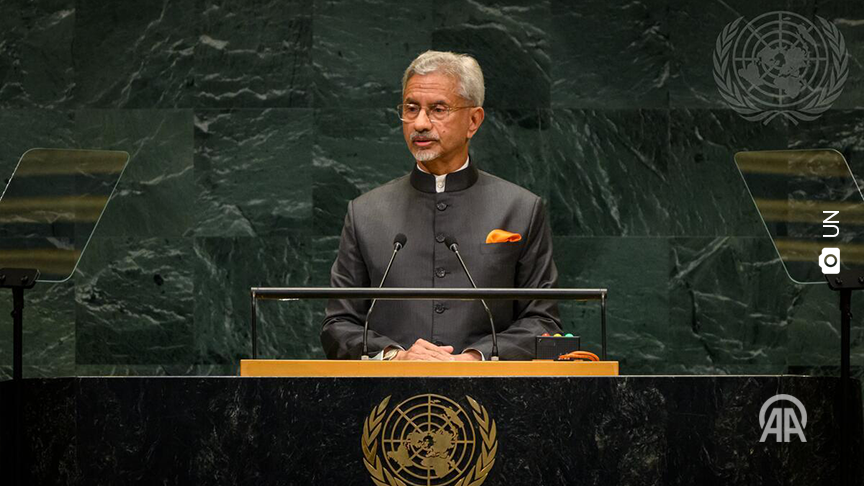
India on Saturday told the UN General Assembly that a two-state solution, amid Israel’s war on Gaza, is needed for lasting peace in the Middle East.
“Tensions and violence also regrettably continue in the Middle East. We strongly believe that a durable and lasting peace requires a two-state solution,” Indian External Affairs Minister Subrahmanyam Jaishankar said in his address to the General Assembly in New York.
India is contributing to humanitarian assistance and relief efforts for the Palestinian people, he added.
Stressing that “new challenges in the maritime domain have added to long-standing ones on land,” Jaishankar said “there have been attacks on commercial shipping and seafarers in the Gulf and from the Red Sea to the Black sea.”
“Indian seafarers have lost their lives, as indeed have others from other nations. This is completely unacceptable,” he said, adding “we must ensure that the safety and security of shipping and seafarers is never compromised.”
Turning to the Russia-Ukraine war, he said the prolonged conflict “is equally concerning.”
“As (Indian) Prime Minister Narendra Modi stated, endless war must give way now, to an end to war. India supports ongoing initiatives to bring peace ... India is prepared to do everything possible, to ameliorate this situation, especially with regard to food and energy security,” he added.
On artificial intelligence, Jaishankar said India views AI as a “transformational driver for human empowerment, economic prosperity, and population-scale problem-solving.”
“We believe in the right of each nation to shape its ecosystem with the development of its own models and deployment strategies consistent with its national goals and priorities. AI will be very much part of our partnership agenda with the Global South,” said the top Indian diplomat.
The world is “well on our way towards a multi-polar world,” he said, adding that the post-1945 order “is giving way to new realities.”
“This process of adjustment, accommodation, and acceptance will not be easy. Much of the turbulence that we witness today emanates from those very difficulties... peace, in a pluralistic order, requires civil conversations … large sections of humanity cannot be excluded from that process. The case for reformed multilateralism only gets stronger day after day,” he said.